A few years ago, I read a novel about a mother who disappeared.
Not metaphorically. Not emotionally. She packed up and physically left.
And there was no explosion. No dramatic unraveling in the kitchen. No police tape or true crime scandal. She simply reached a point where staying felt heavier than going.

And while the socially conditioned part of me wanted to judge her, something quieter inside of me felt something else entirely.
Recognition.
Not because I have ever left my children.
But because I have understood the urge to evacuate.
In the podcast, I shared the mountain cabin I built in my mind — the log house, the wide porch, the slow sunrise without a mental checklist already sprinting ahead of me. That fantasy escape from the mental load of motherhood still exists in my mind.
But here is what I didn’t fully name.
On a few rare occasions, I have physically stepped away.
Once, I went alone to the beach for several days. It was framed as a work project — and it was — but it was also an evacuation. I needed quiet. I needed to think. I needed to remember what it felt like for my mind (and my days) to belong to me again.
Another time, post-pandemic, I rented a small Airbnb and took only the dog. No one needed snacks. No one needed emotional regulation coaching. No one needed me to remember the dentist appointment or the science project. The invisible mental load, the constant emotional labor, were not in the room with me.
But here is the fuller truth.
My oldest is eleven.
Those departures have been rare — though the longing for relief has not been.
But here’s what I am slowly learning: we cannot be fully present in our families if we are constantly counting down to our next escape. Wanting a break is not admission of weakness as a mother or woman. I actually think every mother not only deserves but needs regular breaks. But there is a difference between needing restoration and longing to leave.
For me, growth through motherhood is less about evacuation and looks more like interruption.
Today my breaks are smaller. Sitting in my bedroom window seat reading the Bible. Working on a puzzle. Walking through the grocery store alone. Taking a long quiet walk. These tiny resets are how I care for my mental health so I can stay present, instead of secretly fantasizing about disappearing.
Let’s work together to understand the labor of presence so that we can voluntarily choose acceptance — and this starts with asking, what are we really trying to escape in the first place?
What are we actually trying to escape?
The novel made something clear: the mother didn’t leave because she didn’t love her children.
She left because she felt inadequate. Overwhelmed. Alone in her inadequacy.
And that is the part we don’t talk about.
Modern parenting exists inside a cultural experiment our biology did not design. Anthropologists call humans “cooperative breeders.” For most of human history, mothers did not raise children in isolation. Grandmothers, aunts, siblings, neighbors — a system called allomothering — shared the load. Childcare was communal because survival required it.
Our nervous systems were shaped inside that expectation.
But modern Western motherhood is largely structured around nuclear families operating independently. We are often geographically separated from extended family. We are economically stretched. We are socially connected through screens but relationally thin.
So, when motherhood feels suffocating, it is not necessarily a character flaw. It may be a structural mismatch.
We are biologically built for attachment and shared caregiving.
We are culturally positioned for performance and independence.
That tension lives in the body.
When “I can do it” becomes too heavy
I grew up watching my own mother fight to stay.
She worked relentlessly. She did what it took. She was strong in ways I am still unraveling. I admired her resilience.
And, somewhere along the way, I internalized that strength meant endurance.
Don’t complain.
Don’t crumble.
Figure it out.
And for years, when motherhood overwhelmed me — especially raising a child whose needs are layered and neurologically complex — I did what many women do.
I worked harder.
Harder at career.
Harder at homemaking.
Harder at being patient.
Harder at proving I could handle it.
I once read a post that said, “If you aren’t raising a neurodivergent child, our stories aren’t the same.”
That line lodged in my chest.
Because when your child’s needs are a level up, the cognitive load is a level up. The emotional vigilance is a level up. The advocacy, the appointments, the invisible mental calculations — they multiply.
And the shame multiplies too.
Because if motherhood already feels hard for everyone else, what does it mean that it feels this hard for me?
The hardest part of my story was not the exhaustion.
It was admitting the exhaustion.
Not crying in the closet quietly.
But saying out loud to God, to my husband, to a counselor: “I am overwhelmed.”
Telling the truth is terrifying when your identity is wrapped in competence.
But telling the truth is also the first doorway to relief.
Escape doesn’t always look like leaving
In the novel, someone tells the mother: Call someone who can help you remember who you are.
It is beautiful advice.
But what happens when you feel like there is no one to call?
Modern life has quietly thinned our relational webs. Independence is praised. Self-sufficiency is admired. Even in churches, families often function privately.
Sometimes the only available “escape” feels like productivity.
Pour yourself into career metrics. Or into perfect homemaking. Or into scrolling. Or into self-improvement. Anything measurable. Anything with feedback. Anything that feels winnable.
Motherhood offers delayed reward and invisible labor.
Work offers raises and performance reviews.
Perfectionism offers control.
But none of those actually remove the weight. They just relocate it.
The difference between restoration and evacuation
There is a difference between abandoning your life and restoring your nervous system. I am still learning it.
Total evacuation — disappearing into work, fantasy, or literal distance — gives short-term relief but doesn’t rebuild the structure that caused the collapse.
Restoration is smaller.
Quieter.
Harder, in some ways.
It looks like:
Taking a walk before resentment spills over.
Sitting in silence instead of numbing with your phone.
Saying “I need help” before you are at a breaking point.
Letting someone see your weakness without polishing it first.
It looks like developing boundaries that allow presence to be sustainable.
I have not transformed, just become more aware — which is progress. In fact, I have a bracelet that has been figuratively and actually worn that reads “progress not perfection.” And, while I still default to “I can do it,” I am a step better than I was a few years ago.
And that counts.
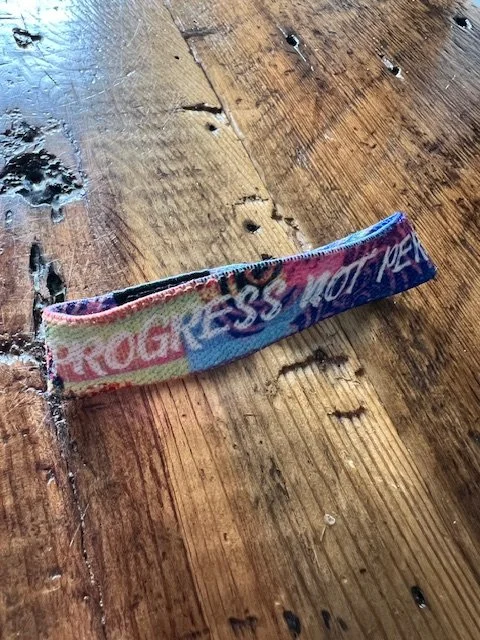
My well worn Zox bracelet: “Progress not perfection.”
It’s okay to feel displaced
Motherhood rearranges identity.
Even when you love your children fiercely, there are moments you may not recognize yourself.
It is okay to feel displaced.
It is okay to need space.
It is okay to admit that the role has become heavier than you anticipated — whether you work full-time, part-time, or stay home.
What is not okay is believing you are uniquely broken because of it.
Research backs this up. Studies on maternal cognitive load show that when one parent carries the majority of the invisible planning, anticipating, and emotional regulation, burnout rates increase significantly. Anthropological research on cooperative breeding reminds us that mothers historically raised children within shared caregiving systems — not in isolation. And large-scale health studies on loneliness link prolonged social isolation to higher rates of anxiety, depression, and even physical illness. When caregiving is isolated and cognitive labor is unevenly distributed, burnout rises. When support systems shrink, mental strain increases.
This is not weakness.
It is biology and psychology.
And if there’s no one to call?
Here is where I land now.
I don’t want you to sit in the shame of thinking everyone else is handling this better.
I want you to know there are more options than disappearing.
I want you to believe relief is possible and you don’t have to prove yourself.
If you feel like there is no one to call, I want to gently remind you:
God’s line is open.
No voicemail.
No call waiting.
No performance requirement before connection.
And sometimes the village doesn’t start with ten women around a table.
Sometimes it starts with one honest prayer.
One honest confession to your spouse.
One counseling appointment.
One text that says, “Want to grab a coffee,” that you’ve been wanting to send but found plenty of excuses for.
Presence is sacred.
According to Howard Hunter, former president of the LDS church, “Motherhood is near to divinity. It is the highest, holiest service to be assumed by mankind.” For me that confirms how “heavy” and important motherhood is.
But presence was never meant to be solitary.
If you have fantasized about the mountain cabin…
If you have wondered whether you might be better at literally anything else…
If you have worked harder instead of asking for help…
You are not failing motherhood.
You are carrying more than one person was designed to carry alone.
And staying — with mental support systems — is a different kind of strength than silent endurance.
May your heart turn gently this week.
Toward your children.
Toward your own limits.
Toward community.
Toward God.
And may you learn the difference between disappearing…and being restored.
Go Deeper: Companion Episode + Heart Check 💖
If this resonated, be sure to check out the companion podcast Episode 10: The Labor of Presence: When Motherhood Feels Too Heavy and the Village Is Missing.
And if you need help naming what you’re carrying, you can download the free Heart Check for Moms — a guided reflection to help you identify where you may be stretched too thin.
You are not alone in this.
And you were never meant to be.
Gracefully Unraveled is a podcast and blog for spiritually curious moms who feel lost in motherhood—gentle, faith‑friendly reflections that untangle identity, emotions, mental load, and burnout so they can parent with more presence and grace. Learn More