I walked into a Carter’s outlet store recently with a mission.
Not nostalgia. Not sentimentality.
Sweatpants. For my boys.
Because if you have elementary‑aged sons, you already know this truth: they don’t actually walk on their feet. They seem to move primarily on their knees. Which means pants are disposable. Sweatpants especially—because unlike jeans, they can’t be patched. They simply graduate into dust rags.
(A side note I learned recently from my mom: old shirt sleeves and pant legs make excellent slip‑on dust rags. She’s been doing this for years without telling anyone.)
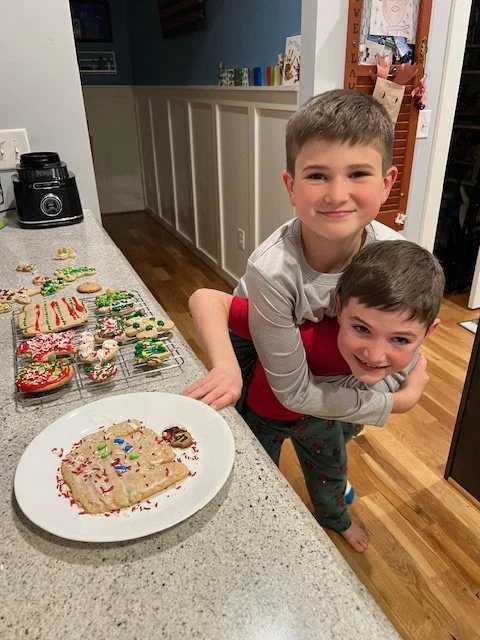
The Lynch brothers
I was fairly certain Carter’s carried what they call “big kid sizes,” so it felt efficient. Sensible. In and out.
But the moment I stepped inside, it was like entering another dimension.
The space felt unexpectedly bright. And not just because of the fluorescent lights, but because the light ricocheted off all the soft colors, like the glow of a full moon on a snowy night. The tiny hangers and clothing so small it looked like it belonged to dolls, suddenly felt displacing. Parents were moving slowly—almost reverently—through the aisles. Exhausted, likely. But glowing in that unmistakable way people glow when they’re in the thick of something tender and consuming and new.
The whole place oozed cuteness, and I felt like an imposter.
My pace quickened instinctively. I had no reason to linger in the front of that store. I slipped toward the back, hoping no one would ask if I needed help—as if being helped might expose the truth.
I found a partial rack and an ill‑stocked shelf with larger sizes. Technically, yes, they would fit my boys—eight and eleven now.
But it was obvious.
They were not the primary demographic.
Carter’s used to be my store—when my kids were babies and toddlers. I could carefully peruse the racks the way I do Publix grocery isles now. But standing there, surrounded by clothes my kids have long since outgrown, I began to realize something quietly and unmistakably painful: I don't fit here, anymore.
As I made my way toward the exit, I overheard two employees chatting at the counter—something about a baby. A hospital stay. New life.
And that’s when it really hit me.
I wasn’t just leaving a store. I was quietly mourning a season.
There would be no more “Mommy’s Number One Fan” onesies. No more elastic‑waist jeans. No more soft, sleepy weight of a baby curled into my chest.
That gentleness—the warmth, the physical closeness, the way motherhood once felt small and protected—has been replaced by hooded sweatshirts and athletic shorts. Loud voices. Wrestling matches. Slammed doors. Things occasionally falling off the wall.
The chaos has changed.
When Seasons Change, Grief Often Follows
From Physical Exhaustion to Relational Loss
Baby and toddler chaos was physical: bottles, naps, diaper bags, strollers, constant touch. School‑age chaos is kinetic and loud—bodies colliding in hallways, games erupting in the living room, arguments that come out of nowhere and escalate fast.
But the hardest shift hasn’t been the noise.
It’s the sadness I've tried to ignore. The realization that my boys don’t need me in the same obvious ways anymore.
I remember the days when my youngest would welcome me into his room to play GI Joes when his older brother didn’t want to. I was the backup plan—and I loved it. Today, he’d rather twiddle his thumbs and wait for his brother than give in and play with me.
Those moments carry their own kind of grief—and if I’m honest, perhaps a flicker of egoic bitterness, too.
But this stage isn’t about being needed less altogether—it’s about being needed differently. Less physically. Less obviously. And more inwardly.
As I stood there near the exit of that Carter’s store, breathing in that space for what felt like the last time, I could feel two things rising at once.
Sadness.
And acceptance.
Not the tidy kind that wraps everything up neatly. But the quiet recognition that I am where I’m supposed to be—even when it hurts.
And there’s research that gives language to this feeling.
Motherhood as a Series of Transitions, Not a Single Identity Shift
Why Grief Returns at Every New Stage of Motherhood
Recent work on matrescence—the transition into motherhood—describes motherhood not as a single identity shift, but as an ongoing developmental process, similar to adolescence. Mothers don’t just become mothers once; they renegotiate who they are again and again as their children grow and their relationships change.
Studies suggest that mothers often experience renewed waves of grief and disorientation at each new developmental stage—not because they regret motherhood, but because attachment is reorganizing. Our identity as “Mom” stretches, thins, and reforms over time.
Newer conceptual work describes parenthood as a series of fragmented transitions rather than a clean before‑and‑after moment. Grief doesn’t only arrive at the empty nest. It spikes at what some researchers call “mini‑leavings”: starting school, moving to middle school, becoming more peer‑oriented, choosing siblings or friends over parents.
And yet, most maternal mental health frameworks still focus on crisis points rather than proactively normalizing these quieter, recurring losses.

Researchers increasingly describe motherhood as a lifelong developmental process, with emotional grief surfacing not only at the beginning or end, but throughout a child’s growth.
So if you find yourself feeling nostalgic, sad, irritable—or even angry in moments you think you “should” be grateful—there may be nothing wrong with you.
Those emotions aren’t signs of failure.
They are signs of love.
They are evidence of attachment shifting, not disappearing.
Normalizing the Emotions We Rarely Talk About
Scripture says there is a season for everything—not a season we rush through or pretend doesn’t hurt. Just a season that arrives or exits whether we’re ready or not.
Psalm 139 offers reassurance, saying, “Even there, your hand will guide me, and your right hand will hold me fast.”
Even there.
Even when we’re standing in the doorway between who we were and who we’re becoming.
I think we’re often tempted to spiritualize acceptance—to believe that if we trust God enough, transitions won’t sting.
But faith, at least in my experience, looks more like standing in the doorway. Naming the grief. Acknowledging the sadness. And still choosing to step forward.
So maybe this reflection is an invitation—to notice the places you no longer fit. The versions of yourself quietly waving goodbye.
And to ask gentler questions like: What did the “mom of littles” version of me love—and what did she lose?
Not so we can cling to the past.
But so we can honor her as we step into what’s next.
Because even here—even now—we are still being held.
Not by nostalgia.
But by grace.
💖Go Deeper: Companion Episode + Heart Check
This reflection began as a Grace Note shared on the Gracefully Unraveled Podcast. If you’d like to listen to the short companion episode, you can find it here: When a Parenting Season Ends: Grieving, Letting Go, and Trusting God.
And if you need help naming what you’re carrying, you can download the free Heart Check for Moms — a guided reflection to help you identify where you may be stretched too thin.
Gracefully Unraveled is a podcast and blog for spiritually curious moms who feel lost in motherhood—gentle, faith‑friendly reflections that untangle identity, emotions, mental load, and burnout so they can parent with more presence and grace. Learn More