If motherhood feels more like obligation than alignment, you are not alone.
For many moms, the hardest part is not loving their children. It is wondering whether they authentically chose the life they are trying so hard to carry.
Why Motherhood Can Feel Disorienting
There was a season when I could feel myself becoming more and more irritated by a life I was supposedly supposed to be grateful for.
That sounds awful to say out loud, which is probably why so many moms never do. But if you have ever loved your children deeply and still found yourself thinking, how did I get here? Was I actually made for this? Did I really want this? then you already know how complicated motherhood can feel on the inside.
That was part of what I wanted to understand when I created episode 12 of the Gracefully Unraveled Podcast: how is it possible to love my children and my life deeply, but still question the choice and my worthiness? The truth I have discovered is that it is not really about whether motherhood was a “right” or “wrong” choice. It is about the difference between a life you arrived at by momentum and a life you keep choosing with your whole self, especially when motherhood has exposed shame, perfectionism, and emotional disconnection.
It is possible to love your life and still feel strange inside it.
It is possible to be devoted to your children and still feel, some days, like you are living a life you did not consciously design.
A person can deeply love her children and still need to revisit the original yes.
That tension is not failure; it is the beginning of spiritual honesty.
“We Can Do It”
I did not grow up fantasizing about marriage and a big family in some steady, settled way. Yes, when I was very little, I played house and cared for dolls like many little girls do. But once I got older, more aware, and more in tune with cultural expectation, motherhood was no longer presented as the prize destination.
My grandmother parented on her own after my grandpa’s premature death, walking through the woods to work each day at the seatbelt factory. I watched my mom do the same for much of my early life, often working Saturdays in an otherwise empty office building. They were most certainly a product of the “we can do it” era, a feminist movement that has continued to reverberate some 80 years later with increased intensity.
In my experience, modern women are taught how to prepare for personal achievement, careers and income. We are taught to build résumés, earn degrees, and think strategically about our future. But most of us are not counseled or mentored in preparation for the emotional and psychological reality of marriage, caregiving, or the identity shift that occurs when we choose to become mothers. We just fall into it.
And that is a strange thing. It can look a lot like a choice you observably saw coming, but there was never a yield sign warning, and you likely hit the gas instinctually as not to lose momentum.

The Choice Beneath Choice
For a long time, I thought choice was mostly about external action.
You decide to date.
You decide to marry.
You decide to have children.
You decide to stay.
You decide to keep going.
But I have come to believe that choice often needs to be deeper than that. It is not only a practical decision or a mental agreement. Some decisions require a heart-center yes. A spiritual consent. A deeper alignment between what you are doing and who you are becoming.
And sometimes that deeper yes does not come early.
That does not mean you are disqualified. It does not mean you are a fake mother or a bad one or a woman who missed her chance. It may simply mean your soul needed more time to catch up with the life your body and circumstances had already entered. And if that is true, then there is grace in saying the yes can still happen now.
Why It Feels So Hard
For years, I struggled to put my finger on the why behind my discontent. I could not seem to do enough, be enough, make people happy enough. I could not fix myself into some calmer, more grateful version of a mother. And despite countless opportunities to blame myself — my temperament, my personality, my early life experiences — the truth is, the root runs deeper and more universal.
Motherhood in modern Western culture often asks women to do something wildly unnatural: become mothers inside isolation. Articles and research on matrescence describe the transition into motherhood as physically, psychologically, and socially profound, yet society often treats it as something women should simply know how to do without community, preparation, or sustained care.
A 2021 survey of 3,349 women in the UK and USA found that 91% believed they were not given enough advice during pregnancy to prepare for postpartum recovery, and about 76% said their postnatal symptoms directly affected their mental health.
We are careful with career preparation. We demand years of education, training, and readiness for work. But when it comes to marriage and motherhood, many women are still expected to just know, even though the psychological and emotional demands are enormous.
The Dark Wonderland
I remember one moment in particular, sitting on the edge of my bed after something had gone wrong, feeling stressed and strangely trapped inside the very life I had once assumed would feel like a dream. I looked around and thought, How did I get here? How can you be living inside a life you love and still feel lonely, unworthy, and somehow displaced in it?
It is a haunting question.
And if I am honest, I fell down the rabbit hole with Alice, headed toward a dark wonderland, more times than I can count. I questioned college choices, marriage choices, where I lived, how many children I had, and whether I had somehow mistaken my way into the life I now had to live.
And this is the real ah-ha I found post recording of episode 12. I did not even understand how much the word choice had been working on me until I decided to flip open an old journal and near immediately saw it staring back at me across a page I had penned years ago.
There it was in my own handwriting: I made these choices, now I have to live with them.
And then, underneath it, the more dangerous question: Did I make the wrong choice?
That is the insidious nature of the egoic mind. It wants immediate relief, simple answers, and self-protective stories. It wants to keep the self safe, even if the story it tells slowly tears the self apart.
And I think this is where shame shows up most powerfully.
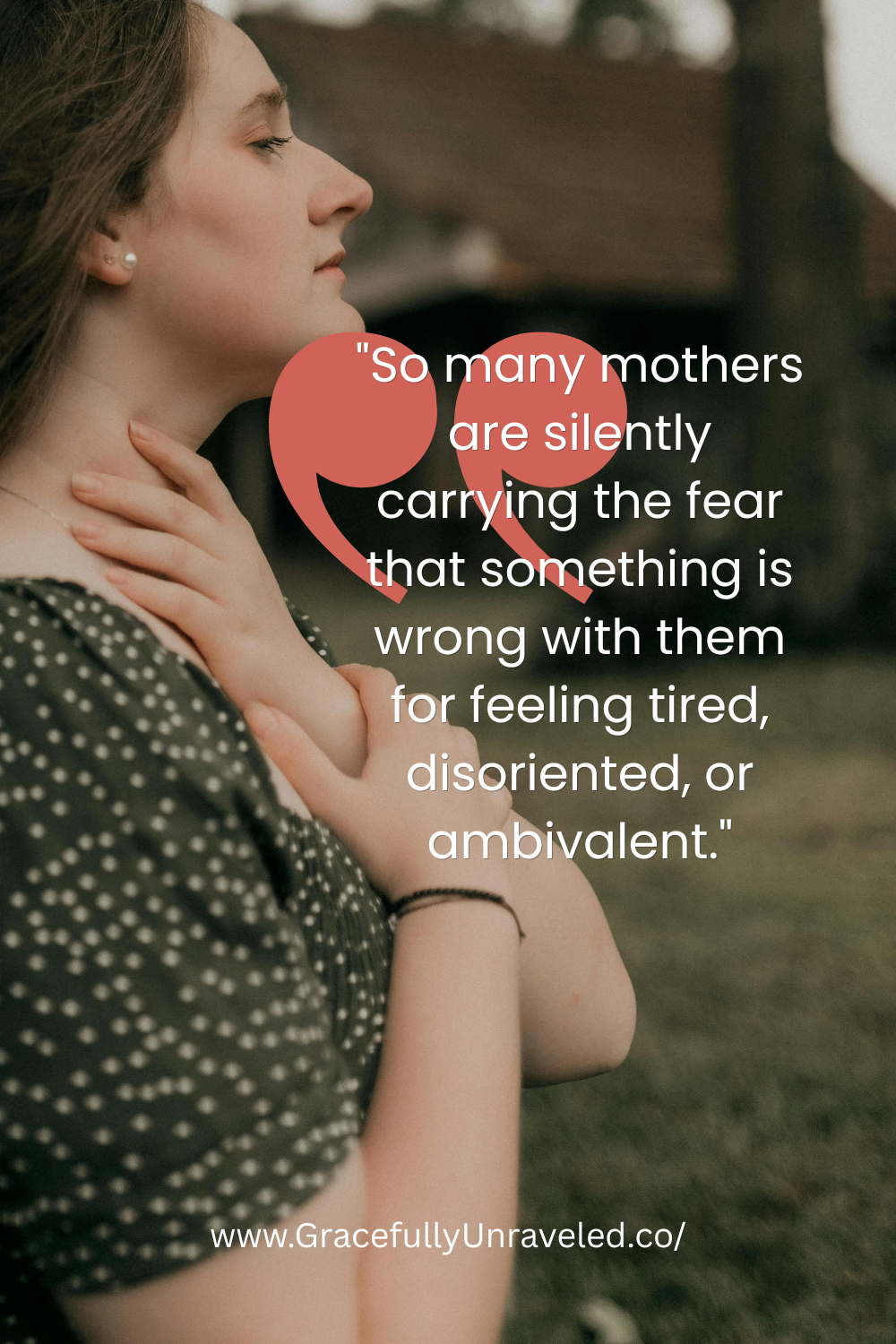
Brené Brown, the acclaimed researcher, author, and speaker on the subject of shame, defines it as the painful feeling that we are flawed and therefore unworthy. And that lands here because so many mothers are silently carrying the fear that something is wrong with them for feeling tired, disoriented, or ambivalent.
Shame loves secrecy, silence, and judgment. It grows when we believe our story should stay hidden. That is why so many mothers do not say out loud what they are really thinking. They are not just afraid of being misunderstood. They are afraid of being disqualified from love.
A Universal Ache
Different cultures name it differently, but the ache of motherhood is familiar. Some traditions understand the early postpartum period as a time that requires community care, not private perfection. The Guardian’s reporting on modern motherhood describes the transition into mothering as a profound loneliness shaped by individualism, isolation, and intensive mothering norms that expect women to be instinctually perfect while raising children inside little boxes. That article also points to matrescence as a developmental stage as significant as adolescence, even though our culture often disavows it.
And returning to Brené Brown, she notes in her book Daring Greatly that “The practice of framing mothers and fathers as good or bad is both rampant and corrosive. It turns parenting into a shame minefield.”
These data points remind us that motherhood is not just about doing tasks. It is about becoming and overcoming.
Inviting Jesus In
The loneliness of those original thoughts was so much heavier when I carried them alone. When I invested more time in understanding my Enneagram personality type and began inviting Jesus into my experiences, I began to notice that the grip of egoic thinking was loosening because the Holy Spirit was taking up more room in my heart.
I do not believe motherhood is only about managing behavior or surviving the day. I believe it is also about spiritual formation. About being shaped, sometimes painfully, into a woman who can see more clearly, love more honestly, and choose more freely.
When I realized that my life was not just a stack of individual, tangible choices, but a collective experience being used by the Universal Christ to shape a story much bigger than me, everything changed. Suddenly my choices had meaning beyond my preference. They had value beyond my comfort. They became less like static facts and more like living invitations.
And some choices are meant to be relived.
Some choices are meant to be recommitted to.
Not because we failed them the first time, but because we may have missed the lesson the first time.
That is what grace does. It does not shame us for needing to come back around. It welcomes us back around.
A More Honest Way to “Choose” Motherhood
I keep thinking about that old journal and the word choice spread across the page.
I was trying so hard to tear down my life and figure out whether I had made the wrong decisions. But now I can see thatthose darker seasons were not wasted. They were revealing where my identity had become tangled up in outcomes, expectations, and fear.
And that is often how God begins to unravel us.
Not by shaming us for the life we have.
But by inviting us to see it more truthfully.
So, if you are in a season where motherhood feels more like arrival than consent, more like obligation than alignment, more like shame than grace, I want to offer you this gently:
You may not need to rebuild your whole life.
But you may need to revisit your yes.
Reframing the yes you may have given previously.
Look for a fresh yes.
A quieter yes.
A spiritually grounded yes.
A yes that says, This is hard, and I am here. God is here too. And today, that is enough.
Choosing motherhood might look like:
Staying present in a moment you’d rather escape
Letting go of the need to get it right
Asking for help instead of proving you can handle it
Letting God meet you in the mess instead of waiting until you feel worthy
It’s not glamorous.
But it’s real.
And it’s enough.
Reflect: What would a fresh yes look like for you today?
Not a perfect yes.
Not a forced yes.
But an honest one.
Given your actual capacity.
Your real mental health.
Your current relationship with God.
What is one way you can say yes to being a mother… today?
📚Books/Authors Referenced This Episode:
Find grace in God's Word with my favorite study bible: CSB Experiencing God Bible
**As an Amazon Associate, I earn from qualifying purchases.
Go Deeper: Companion Episode + Heart Check 💖
If this resonated, be sure to listen to Episode 12: Losing Yourself in Motherhood: From Autopilot to a Conscious Yes to continue exploring the difference between a physical and spiritual yes in motherhood.
And if you need help naming what you’re carrying, you can download the free Heart Check for Moms— a guided reflection to help you identify where you may be out of alignment.
-
Feeling lost in motherhood often means your identity, energy, or expectations no longer feel aligned with the role you’re living every day.
-
Yes. Many mothers experience moments of doubt, grief, shame, or ambivalence, especially when they lack support or feel overextended.
-
A fresh yes is a present-moment recommitment to your role as mother based on your real capacity, not perfection or performance.
-
Faith can help reframe motherhood as something you do with God, not alone, which can reduce shame and create more space for grace.
Gracefully Unraveled is a podcast and blog for spiritually curious moms who feel lost in motherhood—gentle, faith‑friendly reflections that untangle identity, emotions, mental load, and burnout so they can parent with more presence and grace. Learn More